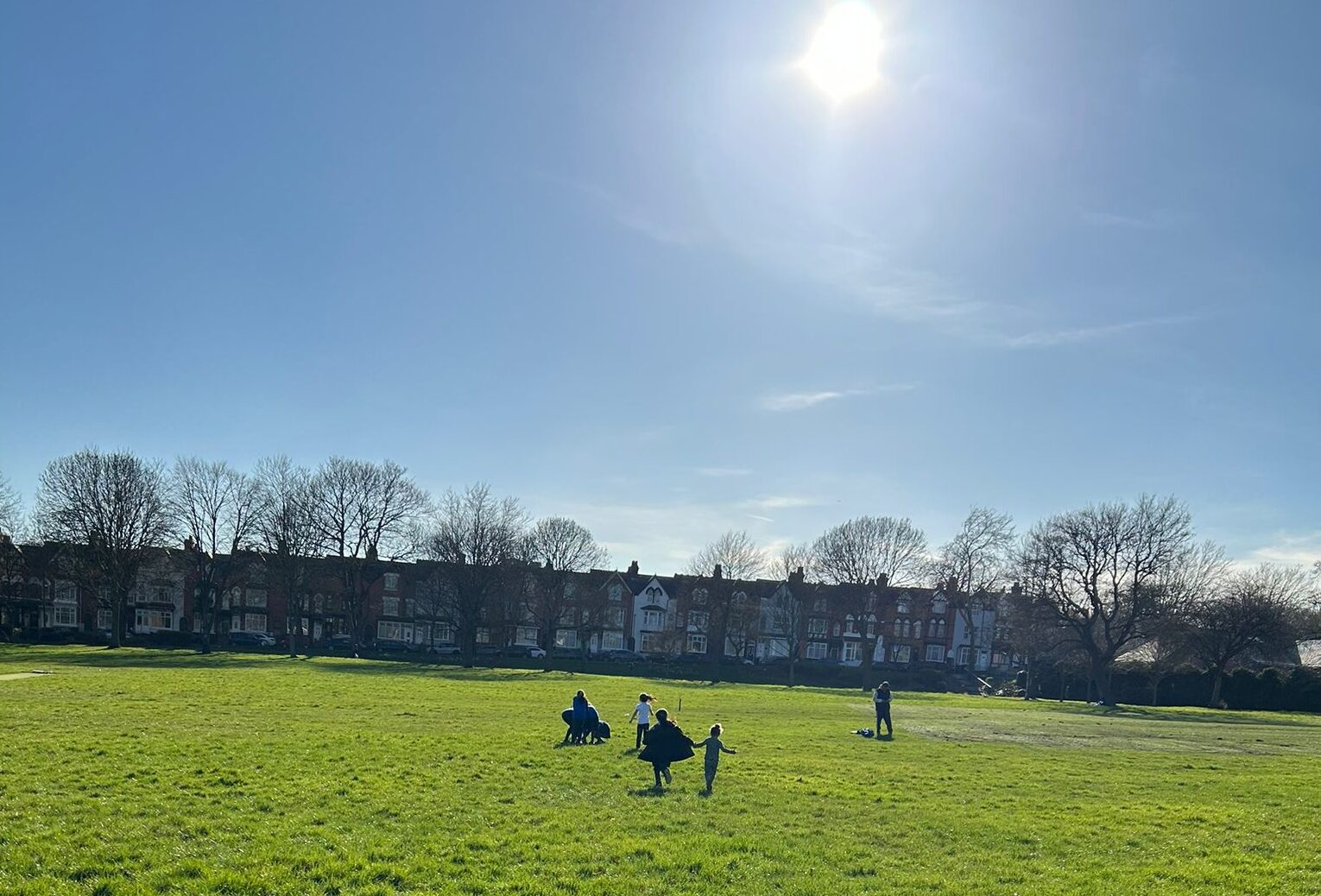
I came across an article the other week that made me stop and think. It ranked the safest and riskiest places in Britain for children to play outside, drawing on data about park provision, pedestrian road casualties, 20mph road coverage, antisocial behaviour rates and more. The methodology seemed thorough, and the result seems to show us where children can roam most freely – and where they can’t.
I scrolled straight to the bottom ten.
Stoke-on-Trent. Blackpool. Newham. Brent. Manchester. If I’m honest, I expected to see Birmingham in there too – and I bet it’s not far off. These are densely populated, under-resourced urban areas where green space is scarce, roads are fast, and the kind of quiet, leafy freedom that outdoor play advocates often talk about can feel very distant from everyday life. Much like many of the areas where we work.
So what do we do with this information?
That’s genuinely the question I sat with after reading it. Reading an article like this can pull you in a few directions at once.
Panic? You could look at the casualty rates and the antisocial behaviour statistics and conclude that the outdoors is simply too dangerous – that the responsible thing is to keep children inside, or outside highly supervised, ‘protected’. Maybe it’s time to move to Wales? Some families arrive at exactly that conclusion, and it’s hard to blame them when the data seems to confirm their fears.
Or you could go the other way entirely: dismiss the findings as scaremongering, insist that children are tougher than we think, and carry on regardless.
But neither of those responses seem to sit right. The risks we are reading about are real – but so is the cost of keeping children away from outdoor free play (and we can’t all up sticks and live in the country).
This research is only scratching the surface. For children with SEND, for whom outdoor play in public spaces already involves a level of risk and negotiation that many families never have to think about, this data is just another layer on top of challenges that are already significant. The sensory unpredictability of a busy park, the lack of accessible equipment and the feeling of judgement from other members of the public. Families navigating all these challenges already don’t need more reasons to stay indoors – they need more reasons, and more support, to go out.
We know what happens when children don’t have regular access to unstructured time outside. They don’t build as much confidence, resilience or ability to navigate risk.
And what happens when those children who’ve been closely supervised throughout childhood, suddenly find themselves expected to manage risk and independence entirely on their own. Freedom doesn’t come with a handy ‘how to guide’.. It needs practice.
What the data is really telling us
The study looks primarily at infrastructure – it counts parks, crossings, speed limits – and don’t get me wrong, these things do matter enormously. A child in an area with few parks, fast roads and limited safe crossing points faces genuine barriers that their counterparts in rural Wales simply don’t encounter in the same way.
But infrastructure alone doesn’t determine whether children get outside. Culture does. Community does. The stories families tell themselves about their neighbourhood, and what’s possible within it.
A family navigating a busy urban area doesn’t experience it as one big block of risk. They know which streets are quieter, which parks feel welcoming at which times, which routes work, they adapt. What the data can’t measure is the mental load that navigation requires — the constant, exhausting work of risk-assessment that falls disproportionately on families in these areas.
What struck me most about the bottom of the ranking, and I suppose this is to be expected – but these are also the areas with the highest levels of deprivation – take Blackpool – #2 of 10 ‘least safe’ on our list, but also where seven neighbourhoods rank amongst the top 10 most deprived in England according to the IMD25.
The families who most need access to safe outdoor play are consistently the families with the least access to it.
This is structural inequality- and it matters because outdoor play is not a luxury, it’s something that we know is essential.
It’s about more than infrastructure
But there is hope! Because if this were purely an infrastructure problem, the only solution would be to wait for better parks and slower roads – and while we absolutely want to see those things, we can’t wait that long.
What we’ve found, working in our own communities, is that the barriers to outdoor play are as much cultural as they are physical. The perception that outside isn’t safe. The habit of indoor life that’s settled in over years, accelerated by a pandemic, reinforced by screens, hardened by a media culture that amplifies every risk and rarely celebrates the everyday freedom of children playing out. The sense that if something goes wrong, it’s the parent’s fault for letting it happen.
This isn’t about underplaying the very real risks that this research identifies. The world does feel like a different place to the one many of us grew up in during the 80s and 90s. Even though our neighbourhoods have genuinely changed, we also need to shift how we relate to them, and that shift is possible. The permission to be outside, to let children take small risks, get muddy, work things out for themselves, isn’t always waiting in the environment. Sometimes it has to be built in community. The Playing Out movement is a powerful example of exactly this: community-led change that starts to move the needle on what feels normal, and what feels possible.
‘As children we were given our freedom to play out all day long completely unsupervised. It’s innate & allows for so many benefits & skills that all children need.’ – ROAM Free Parent, 2020
What we’d like to see
Our work is in communities across Birmingham, which certainly aren’t topping the rankings. That means sitting with the discomfort of what this research shows, and asking what we can actually do about it.
Some of it is structural: more parks, more 20mph zones, more investment in urban green space that reflects where families actually live. Research like this makes the inequality visible, and visible inequality is harder to ignore. We’d like to see it inform policy, both locally and nationally. And it does feel like there is some momentum coming to change in these areas.
But some of it is the work we do every week. Creating spaces where outdoor play feels possible. Showing families that the outdoors belongs to them, even when the data suggests it’s been rather unfairly distributed. Building the confidence, in both children and adults, that comes from being outside together, regularly, whatever the weather.
We can’t fix Stoke-on-Trent’s fast roads. We can’t magically manifest more parks in Brent. But we can keep our work going, shouting as loud as we can that every child deserves the freedom to play outside. Wherever they happen to live.
Interested in finding out more about our sessions, or in bringing something like ROAM to your community? Get in touch